Where the stations really are
The horizon was the first question, the other stations are the second. 3,215 contest logs from two years say where the antennas on the Feuerkogel have to look — and why the second one does not point at Prague.
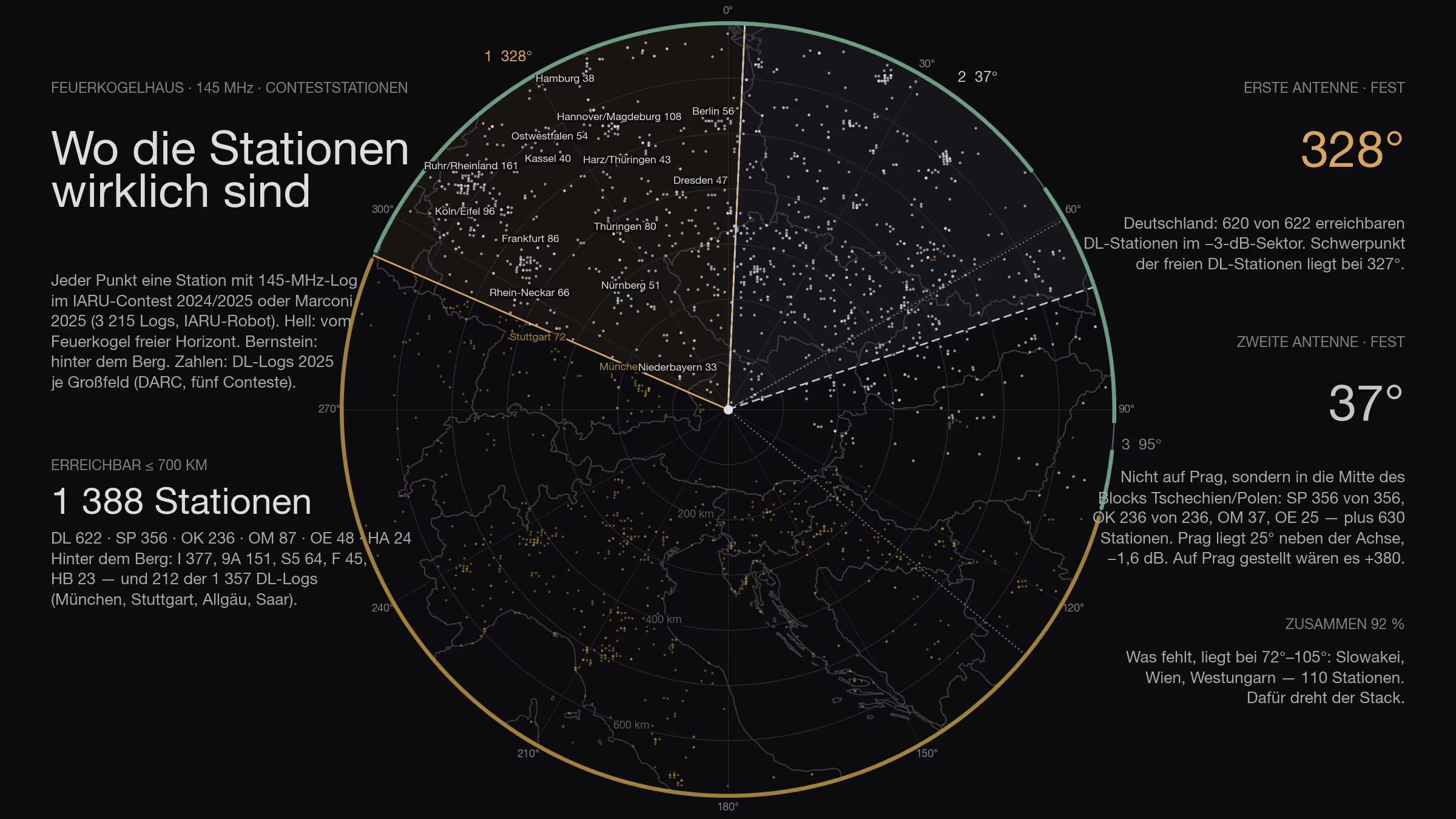
What the Feuerkogel sees, I have worked out: clear from 294° through north to 92°, closed from 106° through south to 293°. That is half the answer. The other half is who sits in that clear half — because an antenna that looks towards the finest horizon is worth nothing if nobody transmits there. For the site at the Gasthaus Feuerkogelhaus I wanted to put both halves together: where the two fixed antennas should point, and where the rotatable one.
This too I did not guess.
Where the numbers come from
Every station that submits a log after a VHF contest appears with callsign and locator in a results list. The DARC publishes its lists with all entrants, the IARU Region 1 robot collects the logs of every country. I took what exists for 145 MHz: the five DARC contests of 2025 — March, May, July, IARU September, Marconi — with 1,357 distinct German stations, and from the robot the IARU contest 2024, the IARU contest 2025 and the Marconi 2025 with 3,215 logs from 35 countries between them.
Each locator yields bearing and distance from the Feuerkogelhaus, and the horizon calculation from the day before says whether that bearing is clear or a mountain stands in front of it. Anything beyond 700 kilometres does not count — not because it would be impossible, but because you do not align an antenna to what works once a year in a tropo opening.
A log is a station that means it. Whoever makes a handful of contacts and submits nothing is missing from the lists. That skews the numbers towards the big stations — for the question of where to point the antenna, that is the right skew.
Germany
Three quarters of all German contest stations lie, seen from the Feuerkogel, between 300° and 340°. The Ruhr and the Rhineland make up the largest locator field, followed by Hanover, Cologne, Frankfurt, Thuringia.
| Field | Region | Stations 2025 | Bearing | Distance | clear |
|---|---|---|---|---|---|
| JO31 | Ruhr, Rhineland | 161 | 312° | 625 km | all |
| JO52 | Hanover, Magdeburg | 108 | 339° | 544 km | all |
| JO30 | Cologne, Eifel, Westerwald | 96 | 305° | 583 km | all |
| JN58 | Munich, Upper Bavaria | 92 | 287° | 188 km | 10 |
| JO40 | Frankfurt, Rhine-Main | 86 | 309° | 458 km | all |
| JO50 | Thuringia, North Hesse | 80 | 329° | 360 km | all |
| JN48 | Stuttgart, Swabia | 72 | 287° | 361 km | 5 |
| JN49 | Rhine-Neckar, Odenwald | 66 | 298° | 406 km | 54 |
| JO62 | Berlin, Brandenburg | 56 | 357° | 518 km | all |
| JO42 | East Westphalia, Weser | 54 | 328° | 609 km | all |
| JN59 | Nuremberg, Franconia | 51 | 319° | 268 km | all |
| JO61 | Saxony, Dresden | 47 | 353° | 395 km | all |
The column on the far right is the one that matters. Munich and Stuttgart, 164 stations together and the nearest big fields of all, lie at 287° — exactly behind the Feuerkogel summit and the Alberfeldkogel. Of 92 Munich stations the house sees ten. With the Allgäu, Lake Constance and the Saarland that makes 212 of the 1,357 German stations that cannot be reached from the Feuerkogel, whatever the antenna. The mountain does not give that away, and it is the price of this site.
The centre of gravity of the reachable German stations lies at 327°. That is, to the degree, the direction the plain area calculation had already given — Germany is densest where it is largest.
The east is as big as Germany
That was the surprise. Within 700 kilometres and with a clear horizon the Feuerkogelhaus reaches 1,388 stations: Germany 622, Poland 356, Czechia 236, Slovakia 87, Austria 48, Hungary 24. Poland and Czechia together are as many as Germany, and they are closer — Prague 300 kilometres, Brno 300, Ostrava 410, Kraków 470.
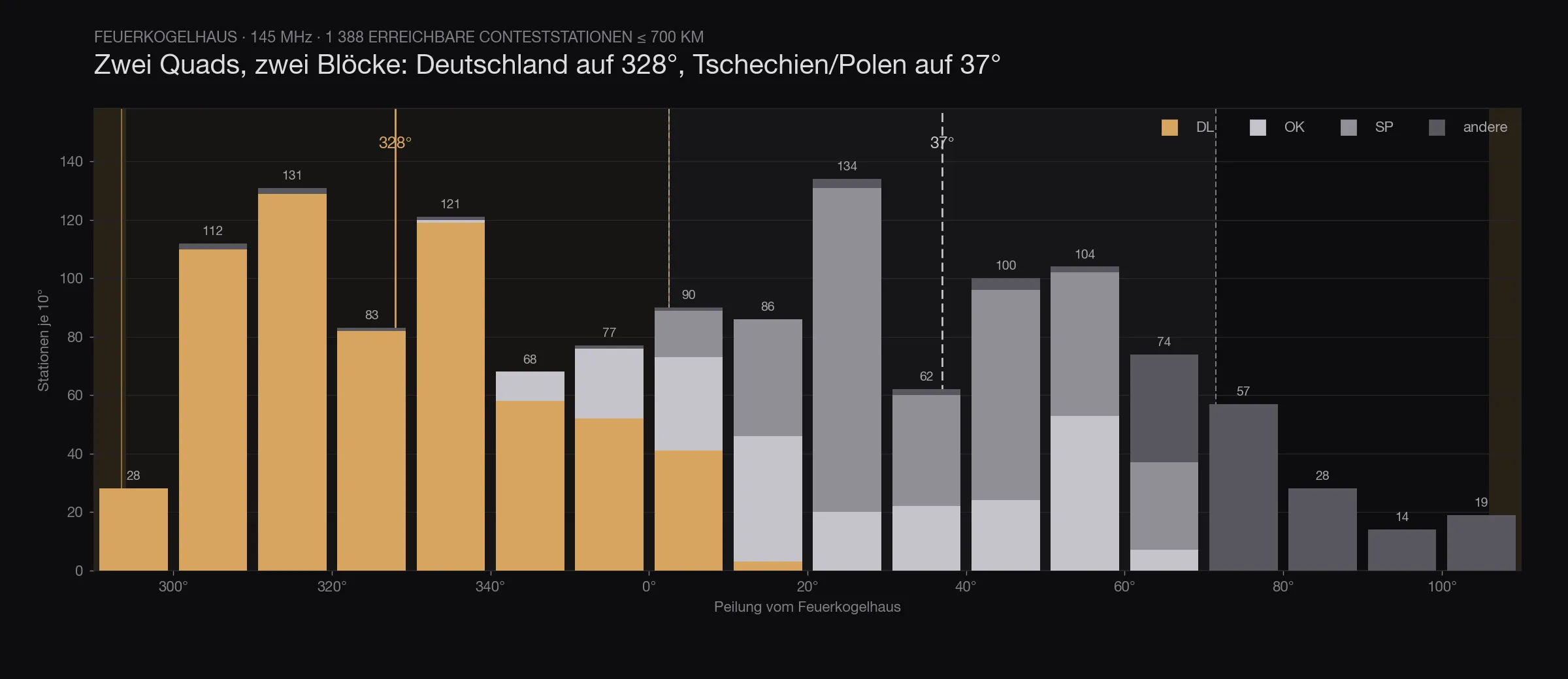
The bars show it more clearly than any map: there are two blocks. One from 300° to 350°, that is Germany. One from 0° to 70°, that is Bohemia, Moravia, Silesia, Poland. Between them, around north, it thins out briefly. And whatever would lie beyond 106° stands behind the Totes Gebirge and the Tauern: Hungary but for 24 stations, Slovenia, Croatia with 151, Italy with 377 stations within range — from the Feuerkogel not a single one of them.
Two fixed antennas
For the two fixed antennas I calculated with the ANJO quad array, because it is 69° wide — wide enough for a whole block to fit in without anyone turning anything. Two of them one above the other on one mast, switched by relay.
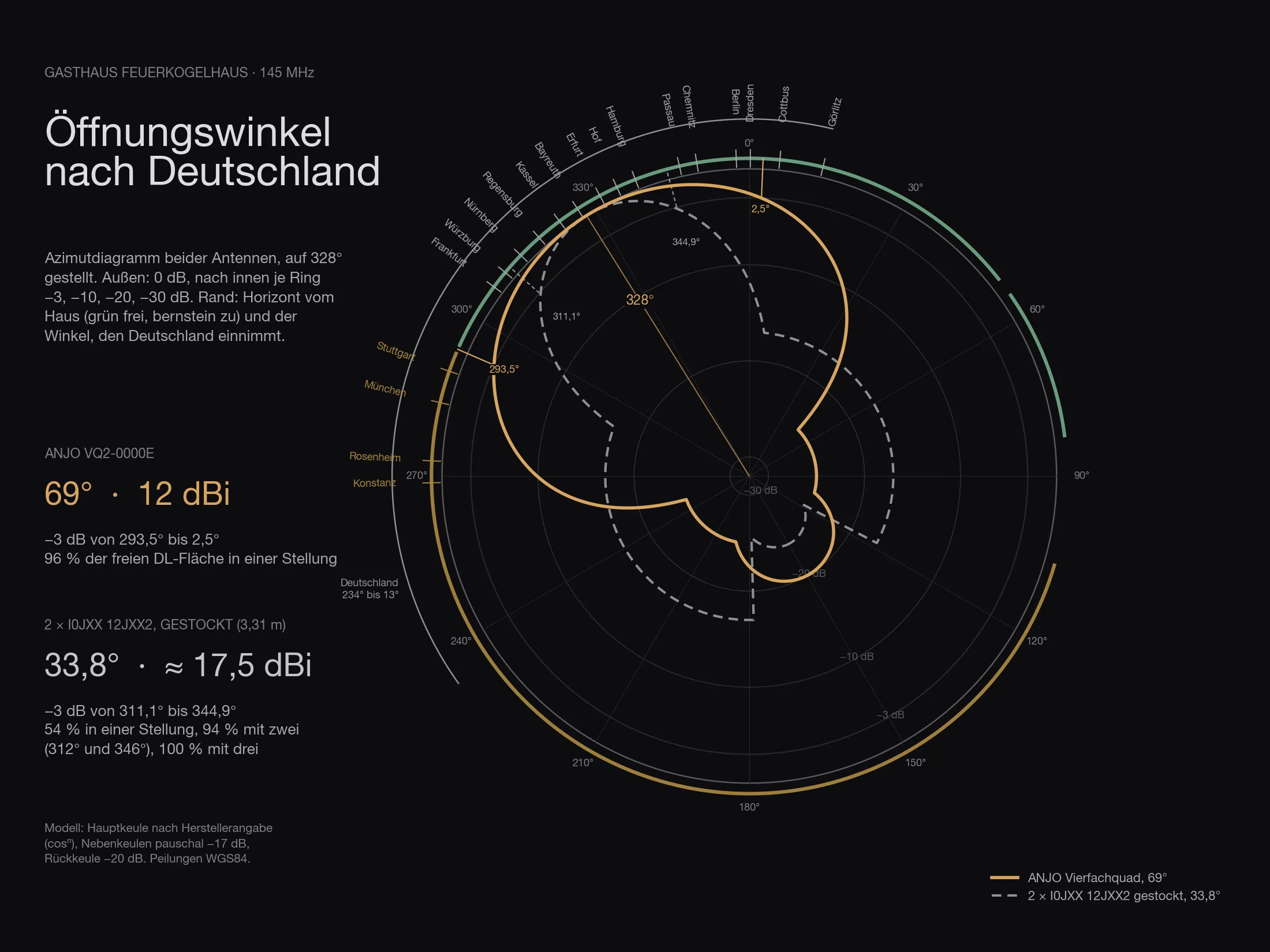
The first at 328°. Its sector from 293.5° to 2.5° holds 620 of the 622 reachable German stations — Cologne and Frankfurt at the left edge, Berlin and Dresden at the right, everything between at full gain.
The second at 37°. Not at Prague, which was the first thought. Prague lies at 11.5°, and a quad pointed there would look from 337° to 46° — the left half of that the first antenna already has, the right half ends short of Kraków, Katowice, Ostrava and the whole of Slovakia. At 37° instead, from 2.5° to 71.5°, sit all 356 Polish and all 236 Czech stations, plus 37 Slovak and 25 Austrian ones. Prague is then 25° off the axis, which costs 1.6 dB and bothers nobody. Together the two fixed antennas cover 92 percent of all reachable stations, and neither ever has to be turned.
A second quad for Germany, by the way, would have added five percent. The second antenna belongs to the east.
Where the stack turns
What is missing is the rest — and the gain. The rotatable antenna is a stack of two 12-element Yagis, 33.8° wide, with a good five decibels more than the quad. For that it has five positions.
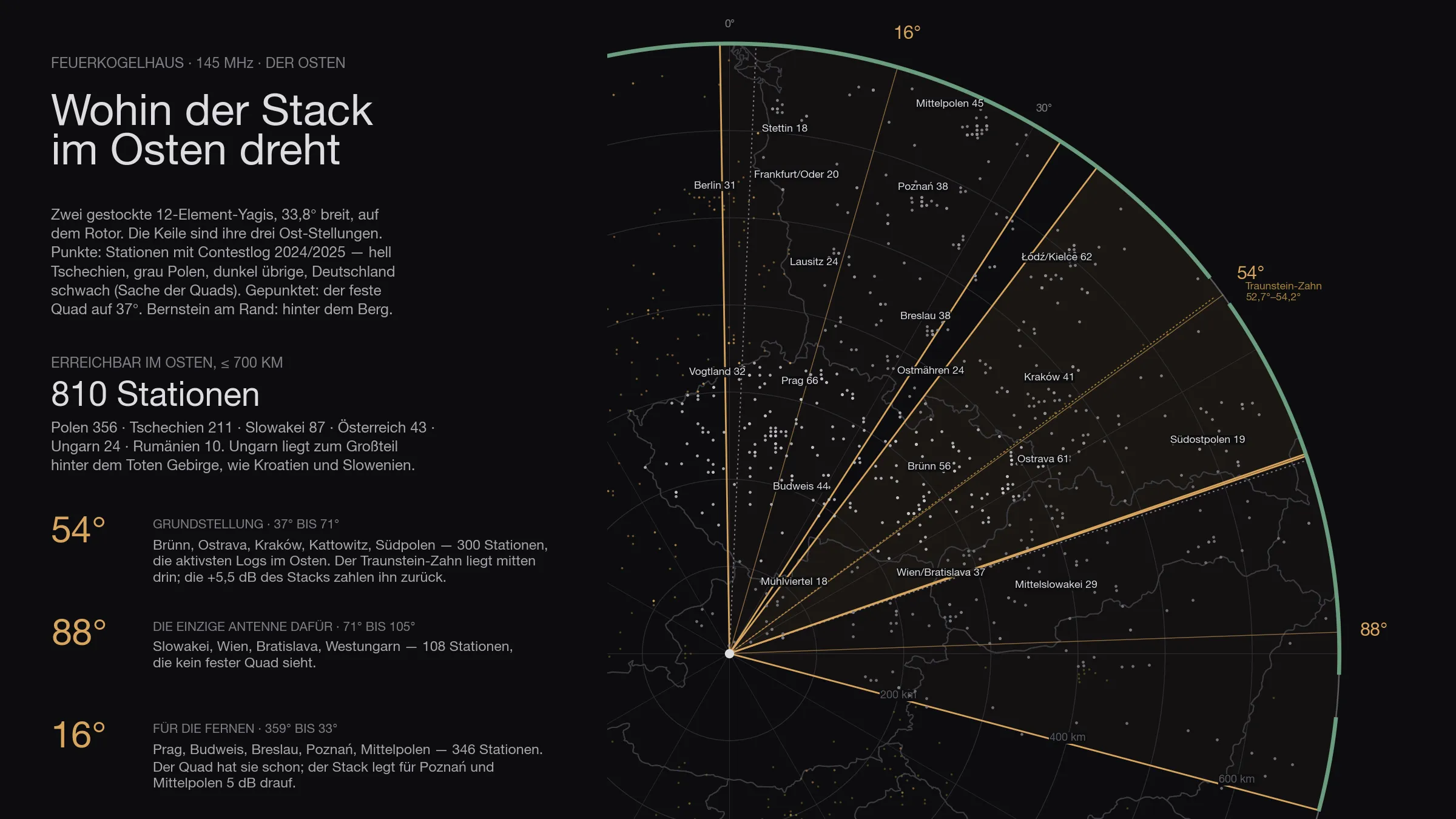
| Position | Sector | Who sits there |
|---|---|---|
| 312° | 295–329° | Cologne, Frankfurt, the Ruhr, Nuremberg — western Germany, the farthest |
| 346° | 329–3° | Thuringia, Hanover, Hamburg, Berlin, Dresden |
| 16° | 359–33° | Prague, Budweis, Wrocław, Poznań, central Poland — 346 stations; the quad already has them, the stack adds five decibels for the far ones |
| 54° | 37–71° | Brno, Ostrava, Kraków, Katowice, southern Poland — 300 stations with the most active logs in the east |
| 88° | 71–105° | Slovakia, Vienna, Bratislava, western Hungary — 108 stations no fixed quad sees |
The 54° position has one more reason. At 53° stands the Traunstein, the one notch in the clear horizon: 1.6 degrees wide, +0.27° high, and right behind it Brno and Katowice. It costs three to five decibels of troposcatter there. No mast helps against it — you would need fifty metres more — but the stack pays it back with its gain. And 88° is the position for which there is otherwise no antenna: Slovakia and Vienna lie outside both quads, and a third fixed quad for them would have half its beam in the Totes Gebirge.
Caveat
These are logs, not stations. Whoever does not submit is missing; whoever was not on in 2024 and 2025, too. Two years are a sample, and a good tropo evening shifts everything north. The horizon calculation still knows neither the house nor the cable-car station next to the mast, and the Kasberg at 94° makes Budapest, at +0.16°, a question of diffraction rather than yes or no.
What the calculation says for certain: the first antenna looks at Germany, the second at Czechia and Poland, and the third turns. The rest gets measured — up there, with an antenna.
73 · OE5SOS