The two radios I write the software for
Two boxes on the same desk, about the same size, both hooked up over LAN — and yet two completely different relationships to the software.
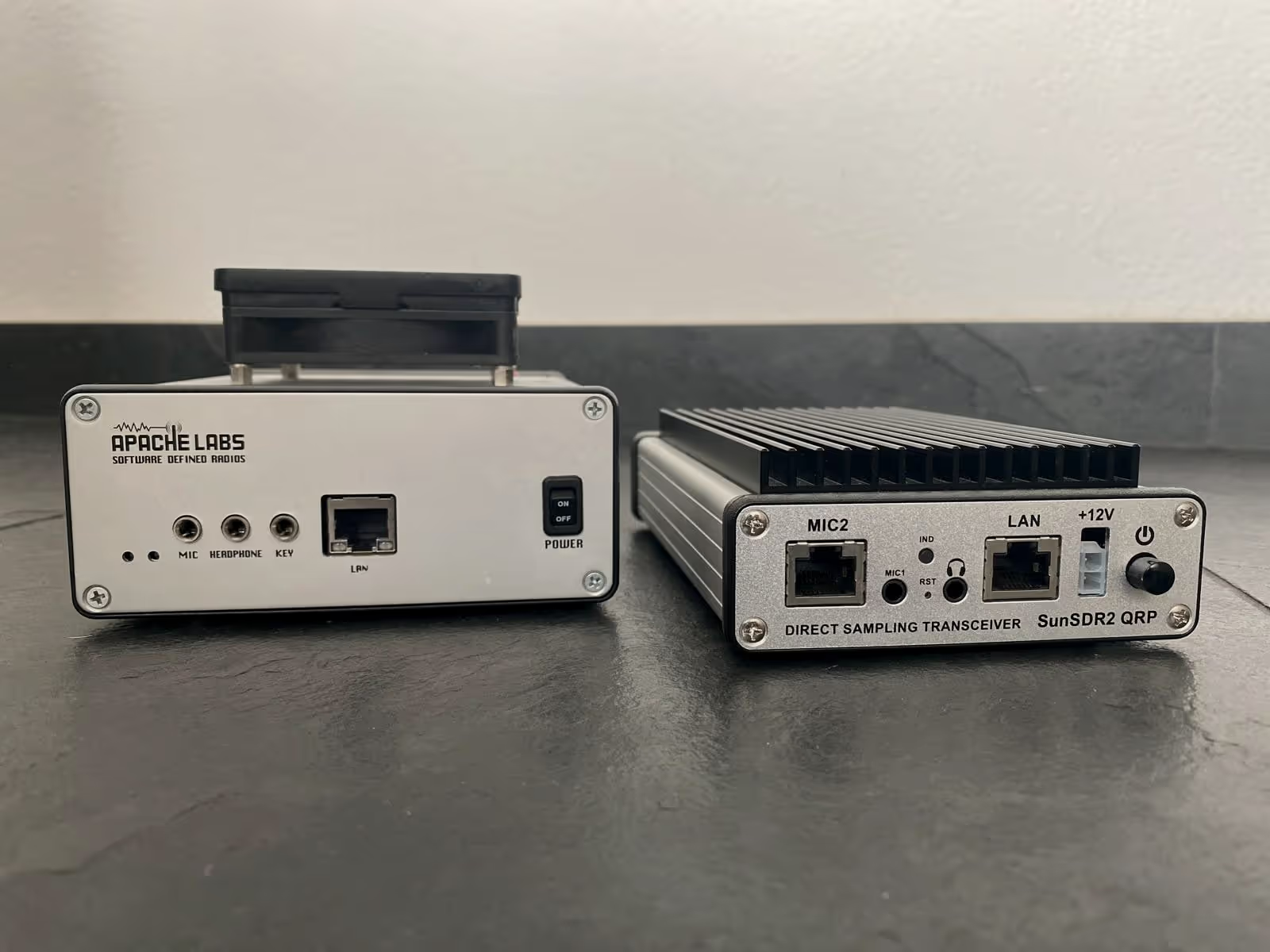
On the left the ANAN-10E from Apache Labs, on the right the SunSDR2 QRP from Expert Electronics. From the outside almost identical: a hand’s width across, LAN in, headphones and microphone up front. You wouldn’t guess that, in software, they’re two completely different things.
The difference isn’t in the metal
With the ANAN-10E, Longpath does the computing. The radio announces itself as a Hermes, speaks OpenHPSDR, and what comes out of the box is raw I/Q data. Filtering, demodulation, noise reduction, the whole transmit chain — all of that happens on the computer, in WDSP. The box is basically an analogue-to-digital converter with a network port. That’s exactly why I can change anything about it: there’s no point where a foreign signal path begins.
With the SunSDR2 QRP it’s the other way round. Expert Electronics doesn’t publish its protocol. There’s nothing to write a driver against. The only way in is TCI — the same protocol Longpath already exposes outward, so that WSJT-X and N1MM can drive it. Just reversed: here Longpath is the client and ExpertSDR2 is the server.
I can’t demodulate anything there. I can only ask for the result, take it, display it, and make it audible.
That sounds like less, and it is. But it means a radio that doesn’t speak OpenHPSDR at all still ends up in the same window — with the same waterfall, the same audio, the same tuning.
What the photo shows
The cooling already tells you something. On the left sits a bolted-on fan on top, a visibly retrofitted addition. On the right the heatsink is part of the housing — the same job, solved in the design instead of after the fact.
Among the connectors, the second microphone jack stands out: besides the 3.5 mm input, the SunSDR has an RJ45 jack for hand microphones with a button strip. Plus its own power button instead of a toggle switch, and a separate 12-volt feed.
And yes, both go up the mountain
Not at the same time, and not on every trip. But that’s exactly what they’re for: small enough for the backpack, frugal enough for a battery, and capable enough that five watts from a summit reach further than a hundred from the valley.
Whatever I miss on the mountain sooner or later turns into a change in the program. That’s the real reason I do both — the radio and the software. One writes the other’s task list.
73 · OE5SOS